
02 September 2026: The Indian Institute of Technology Kharagpur (IIT Kharagpur) and Mumbai Port Authority (MbPA), in collaboration with the Archaeological Survey of India (ASI), have launched an ambitious interdisciplinary research project to investigate how past climate and sea-level changes may have influenced maritime trade and human activity around Elephanta Island and India’s western coast.
The project brings together advanced earth-science techniques and archaeological evidence to reconstruct past sea levels, climate conditions and maritime activity from the early historic to medieval period. Mumbai Port Authority has pledged ₹1 crore for the project.
The intergovernmental panel on climate change predicts a global sea level rise somewhere between 0.4 to 0.8 meter by the end of 2100. For the western coast of India, the rise might be even up to 1 meter that will not only submerge all the low-lying areas of Mumbai but will also submerge the areas around the Elephanta island that hosts 1500-year-old iconic rock cut caves of Lord Shiva, a UNESCO heritage site. Today the island can only be approached by small boats as the water depth at places goes down to 5m, inoperable for large vessels that need at least 12-15 m water depth. But imagine if the sea level was high enough in the ancient past, could it be possible for large ships to dock around Elephanta just as they do today at Mumbai harbour?
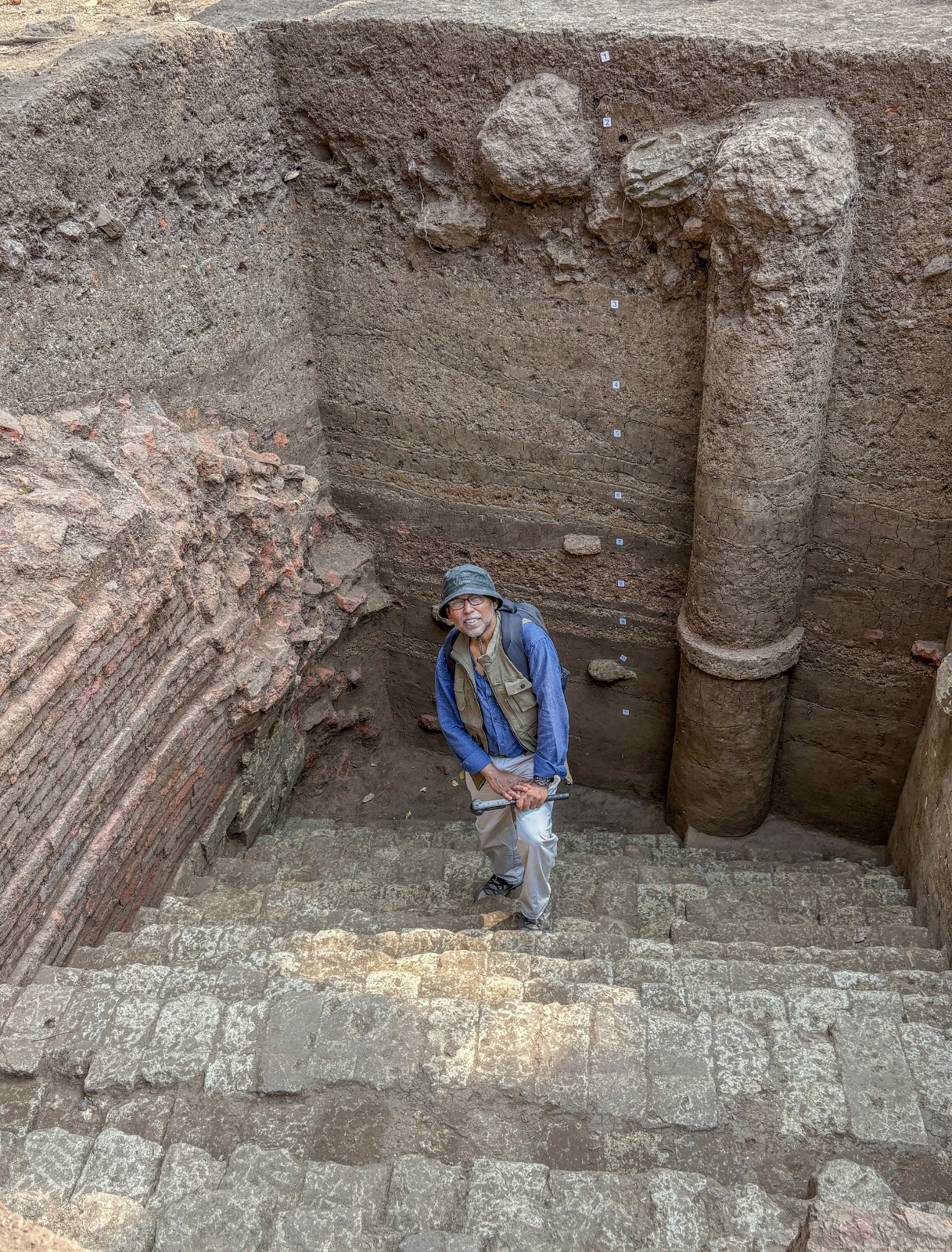
This is exactly being probed in a project jointly launched by IIT Kharagpur and Mumbai Port Authority (MbPA) in collaboration with Archaeological Survey of India (ASI). The project will address the effect of climate change and sea level on maritime trade activity from Early historic to medieval period i.e., 1500-1000 year before present and will have important bearing on the future effect of sea level due to on-going climate change. Mumbai Port Authority has pledged one crore for this ambitious project. Recent excavation headed by Dr. Abhijit Ambekar, Archaeological Survey of India has revealed hitherto unknown history of the Elephanta island that is fascinating. This pushes the history of the island to deeper time beyond the rock cut caves. Deep excavation yielded a massive 165 Sq. metre and 8 m deep structure of rectangular reservoir connected with a perpendicular stepped junction (T-shaped stepped tank) or an ancient stepwell for regular use of stored freshwater that is scarce in this oceanic island even today. Today most monsoonal rain falling on the island is lost to the Arabian Sea as surface run-off with little groundwater storage and must have been the case in the past too necessitating this ancient hydraulic engineering marvel of water management. The findings suggest bustling human activities on this remote island 1500 year ago.
“Our excavation at Morabandar of Elephanta island yielded gigantic storage jars, Indo-Mediterranean (Roman) amphora sherds, Turquoise Glazed Ware, Torpedo jars of Mesopotamian origin. Mediterranean amphorae jars were normally used to transport liquid commodities including wine, oil, and fish sauce. Submerged wharf structures, intertidal habitation debris, and multiple watermarks on port installations during this excavation suggest that Elephanta was not an isolated ritual site but was integrated into wider circuits of maritime movement,” said Dr. Abhijit Ambekar, Archaeological Survey of India.
“Presence of this settlement, huge recovery of imported Roman and west Asian artefacts, along with large anchoring stones at Elephanta hint at large-scale anchoring or transhipment activities that could not be possible without large vessel movement around the island. We would like to reconstruct the past climate and sea level by using state of the art scientific tools available at IIT Kharagpur. The modern terrain, with two hills divided by a tidal valley surrounded by low-gradient, mangrove-fringed foreshores, makes the island highly sensitive to even minor sea-level shifts. Scanty geological records suggest fluctuation of the order of 5m along the west coast over the last 5000 years. We would like to drill several cores around Elephanta and other parts of west coast and study the sediments for radiocarbon dating, sediment sources and oxygen, carbon and nitrogen isotopes for reconstructing both climate and sea level in the past,” said Prof. Melinda Bera of the Department of Geology & Geophysics, IIT Kharagpur, and Principal Investigator of the project.
“We will also analyse the archaeological potsherds and jars for their strontium and neodymium isotopes as they can pinpoint and trace the exact locations of the soils used for manufacturing these pots and jars,” said Prof. V. Ravikant, a co-investigator and expert in radiogenic isotope studies.
“History of the Indian maritime trade with Egyptian and Mesopotamian kingdoms is as old (~5500 year) as the Indus valley civilization that continued till the early historic period as found by our studies at the 2800-year-old archaeological settlement of Vadnagar, Gujarat. During the Early medieval period too a number of active ports and trading centres existed at Bharuch, Nala Sopara and Chaul of west coast as written in first century Greek sailor’s manuscript ‘Periplus of the Erythraean Sea’. Some of these for example, Nala Sopara declined around 5th century CE while trading flourished at Elephanta. It would be interesting to see if climate and sea level change had any effect on these socio-economic dynamics. Our earlier isotope-based studies indicated the profound effect of climate change on ancient human settlement and migration,” said Prof. Anindya Sarkar, Head of National Stable Isotope Facility at IIT Kharagpur and Advisor to the project.
“Indeed, Elephanta opens up a new avenue for scientifically studying the ancient maritime trade of India,” said Ajay Yadav, a research scientist and expert in ancient trade currently working at the University of Oxford and associated with the IIT group.
The interdisciplinary initiative is expected to provide new scientific insights into the relationship between environmental change, coastal geography, ancient settlements and maritime networks. By combining archaeological discoveries with IIT Kharagpur’s capabilities in isotope geo-chemistry, sediment studies, radiocarbon dating and paleoclimate reconstruction, the project also seeks to build a deeper understanding of how coastal systems responded to sea-level variations in the past—knowledge that could have relevance in the context of present-day climate change.
_20260902155042_f2907e.jpeg)
(PIB)



0 Comments